http://blogs.timesofisrael.com/the-charlottesville-address/
MNUnterberg
Tuesday, August 22, 2017


Monday, December 28, 2015
The Lynchpin - Understand the “Other”
The Middle East is a complicated neighbourhood, often making it difficult for Westerners to understand. However, there are two conflicting outlooks that lie at the heart of the Arab/Israeli conflict. To understand this disagreement is to hold the key to understanding all aspects of this lasting crisis. It comes down to this:
There are two ways to understand the modern state of Israel.
- The Jews are a semitic nation returning to their homeland in the Middle East.
- The Jews are a religious community stuck in the Middle East by Western colonial powers after the Holocaust.
Let’s call the first opinion “Z”, as it is the underlying belief of Zionism. We’ll call the second one “A”, as it has been adopted by the majority of Arabs and Muslims around the world. Once one of these perspectives is chosen, one can understand both sides of the conflict.
Consider the classic questions debated on this topic, and you will see how A or Z will determine your answer.
- Is Israel a colonial power? According to Z, it can’t be. According to A, it can only be.
- An Apartheid state? According to A, Israel is racist and discriminatory based on religion. According to Z, the Jewish nation treats its Arab citizens as equal, and allows Jewish nationals to return home.
- Should five million Palestinian refugees be told that they will receive homes throughout Israel? According to A, the Right of Return is the only just solution. According to Z it would mean the destruction of our third Jewish State, and Arab refugees should be treated the same as any other refugees after a war.
- Should there be one state for Arabs and Jews in Palestine? According to A, there is no reason people of the Jewish faith couldn't live in a Arab/Muslim country as they have for ages. According to Z reestablishing our national statehood after 2,000 years as wandering refugees is not something to be surrendered for any reason.
- What was the Zionist movement doing for decades before the Holocaust, starting in the mid 19th century? And why were so many of its members and leaders non (if not anti) religious? According do Z this is self explanatory. It was trying to reestablish Jewish self rule in their national home, and break with Rabbinic acquiescence to exile. This is often ignored by A.
One can continue along the same lines ad infinitum. If there is an aspect of this conflict that these two understandings don’t explain, I haven't figured it out yet. I’d be happy to learn if this is not the case, but it seems clear that this a major point of contention, if not the major point.
The tragedy lies not in the Arab and Muslim world not accepting premise Z. One can argue with reasonable people in support of A or Z, but ultimately they can decide which approach is best. This decision can be based on which is better supported by facts as evidence, which will create the possibility for better outcomes, or really any criteria they see fit.
No, the tragedy lies in the fact that so many of those who have chosen A refuse to believe that those who have chosen Z really believe it! That they have devoted their lives to this idea, and are willing to die for it. Even sacrifice loved ones for it. Violence and public relations attacks work as tactics to remove a colonial power. Against a native population, however, it will only entrench and marshal the people.
One can be concerned about Palestinians and subscribe to approach A or Z. But to deny the reality that millions who live in (and out of) Israel hold Z to be self evident, is to doom Palestinians to a future of failure and suffering.
 |
| Is that a goblet, or two Semites arguing? |
I'm just saying.
MNUnterberg
Sunday, January 11, 2015
A time to be polite, and...
This post will be a response to a Facebook post that I read today, so let me first quote it for context:
I believe that these are the various points raised in these quotes and in other comments from the thread. (I am open to correction or tuning if I am erring in any way)
I would like to respond without hyperbole or false analogies, so please let me know if I have failed in that attempt. (I am a moderate fellow by nature and inclination, and rarely find myself as the advocate for intemperance or any level on insensitivity, so please excuse these caveats)
Here goes:
I sympathise with the sentiments expressed as a person living today.
By that I mean January 11th, 2015 C.E., not modern times in general.
Because when I look at history more broadly, my perspective is entirely different.
1. "Now is not the polite time".
This in and of itself is not compelling, and troubles me a great deal. When life and limb are at risk, there is no time to worry about politeness.
When the NRA says after the Sandy Hook shooting, "Now is not the polite time", I think that is an attempt to avoid the uncomfortable truths at hand.
When there is an entrenched social ill, and cultural inertia makes it almost unchangeable, then the time of pain after tragedy may be exactly the time to raise the issue. An incident that gives an opening for an intervention may be too precious an opportunity to waste.
If someone thinks that Aliya will not make French Jews safer, then there is obviously no reason to recommend it. But if they think it will, it may be their responsibility, if not obligation.
Obviously, people who are direct victims of a tragedy should not be lectured to. People with their loved one's bodies before them cannot learn, they can only mourn. That is a side issue though. With the exception of a few families, the Jews of France are not direct victims.
Forgive me is I seem callous. But not everyone is a victim. There are apparently around half a million Jews in France, and around half of those live in the greater Paris area. They must be shaken, but few are experiencing trauma of personal levels.
Doctors commonly used to withhold upsetting information from patients. We no longer do that for good reason.
2. "Israel is not really safer than elsewhere in the free world".
Perhaps this is true on an individual level. Perhaps not.
But if we are talking about the Jewish people over time and generations, then this is, from a Zionist perspective, absurd.
Zionism can be reduced to the following four beliefs:
But from when Herzl called together the first Zionist Congress till today, these are the uniting principles that unite all believers in the movement. The pioneers of Aliya risked their lives, because they believed that individuals must do so for the greater security of Jews in the future!
So this or that Jew may or may not be safer in Israel. But the Jews certainly are. (according to Zionists) And so Jews should come here.
A true story:
I have a friend from high school who lives in Paris, France. (unusual for a boy from Brooklyn, but there you go) He wants to make aliya, but is having trouble convincing his wife. She does not want to leave her parents, and they want to stay in Paris.
"What do they say when you talk to them about safety", I asked him.
He answered, "They say things things happen from time to time. You have to be patient and wait for them to blow over, and things will be better."
Needless to say, this sent chills up my spine. As it should anyone who knows that the 20th century happened.
And safer in France? FRANCE? France is not Beachwood.
Let's leave aside the medieval history of pogroms, book burnings and expulsions. Let's say that their leading the Emancipation absolved them from that history.
Let's forget that when the allied Italians dragged their feet and handed few Jews over to the Nazis, the conquered French immediately helped organize and deport 75,000 Jews. Well, to be fair, adults, as they didn't want to deport children. Then they waited till they got too difficult to take care of all those orphans and departed them too. Au revoir, les enfants.
Let's forget all of that as ancient history as well. Forget all of that.
France has been dealing with terror for decades, arguably far less successfully than the IDF. The terrorist from the Jewish supermarket was convicted for plotting to break out the mastermind of the 90's bombings by the GIA. And he was released early. In 2013.
Why is France in Islamist cross hairs? Is it their war against terror statehoods in Africa, Mali in particular? Is it the size of the muslim population? Is it the deeply pervasive secularism? Probably all the above and more, and don't expect it to change soon.
And ask a kippa wearing tourist about the advice he receives when in France. It is recommended that he behaves as French Jews do, and take it off in public for fear of safety.
France is not Ohio. Israel is not France.
And I think Gordis is wrong as well. As I have in the past.
3. "Refuge is not a good reason to make aliya".
Really? We are judging good reasons to do what's right? Most olim have moved here ideologically? 3rd, 4th, 5th, Morrocan, Yeminite, Russian and Ethiopian aliyot aren't as good as the ideological ones? Mitoch shlo lishma is irrelevant?
Do I need to quit smoking or protect the environment for the right ideological reasons?
I really didn't get that one.
4. "Recommending Aliya by people who live in Israel sounds boastful."
So do it carefully and sensitively. The fact that Hocheach Tocheach, rebuking your neighbour, is a difficult mitzva does not mean we are not obligated to attempt it. Do it humbly. At least do it a lot more humbly than Ben-Gurion did it. Jabotinsky didn't live in Israel, and delivered it pretty directly.
The who matters. I think Israeli political leaders have a responsibility to represent the welcoming aspect of the Jewish home.
A Zionist has an obligation to preach the dream. Just do it like a mensch.

And kol hakavod to the French PM on his handling of the situation. But I don't see it as our mission to save the French Republic.

MNUnterberg
Have to get this off my chest: with much respect, not a big fan of the Zionist sentiments being expressed by some in response to the horrible tragedies in France.
First, sadly, it's not as though Israel is some bastion of security from terrorism. This, imho, is not a reason to make aliyah. (That we have an army and control our fate to a greater degree IS - but that is a different point, I think, than the argument that seems implied by some recent statements.)
Second, there is a time and place. To tell a community in trauma and in mourning - Come make aliyah! - just feels a bit insensitive. Let's talk about that (if at all) later, but not now. To be clear, I respect where these statements are coming from, but I think these kinds of reactions may not be the most appropriate right now.Later:
...refuge per se doesn't really work anymore. Honestly, /i was probably safer living in Beachwood Ohio than I am living where I do today. As Daniel Gordis has argued (cant find in writing right now-I've heard him say this in person) you can't really base Zionism on safety and refuge, like we once did. It just doesn't ring true in this day and age. We are a sitting target for Iran, not to mention Palestinian terrorism...That being said, it's all worth it to me because the very fact that my nation controls its destiny in being able to defend itself as best as possible is a mark of national dignity and health. (Besides for the other reasons that led me to make aliyah.)
I believe that these are the various points raised in these quotes and in other comments from the thread. (I am open to correction or tuning if I am erring in any way)
- "Now is not the polite time".
- "Israel is not really safer than elsewhere in the free world".
- "Refuge is not a good reason to make aliya".
- "Recommending Aliya by people who live in Israel sounds boastful."
I would like to respond without hyperbole or false analogies, so please let me know if I have failed in that attempt. (I am a moderate fellow by nature and inclination, and rarely find myself as the advocate for intemperance or any level on insensitivity, so please excuse these caveats)
Here goes:
I sympathise with the sentiments expressed as a person living today.
By that I mean January 11th, 2015 C.E., not modern times in general.
Because when I look at history more broadly, my perspective is entirely different.
1. "Now is not the polite time".
This in and of itself is not compelling, and troubles me a great deal. When life and limb are at risk, there is no time to worry about politeness.
When the NRA says after the Sandy Hook shooting, "Now is not the polite time", I think that is an attempt to avoid the uncomfortable truths at hand.
When there is an entrenched social ill, and cultural inertia makes it almost unchangeable, then the time of pain after tragedy may be exactly the time to raise the issue. An incident that gives an opening for an intervention may be too precious an opportunity to waste.
If someone thinks that Aliya will not make French Jews safer, then there is obviously no reason to recommend it. But if they think it will, it may be their responsibility, if not obligation.
Obviously, people who are direct victims of a tragedy should not be lectured to. People with their loved one's bodies before them cannot learn, they can only mourn. That is a side issue though. With the exception of a few families, the Jews of France are not direct victims.
Forgive me is I seem callous. But not everyone is a victim. There are apparently around half a million Jews in France, and around half of those live in the greater Paris area. They must be shaken, but few are experiencing trauma of personal levels.
Doctors commonly used to withhold upsetting information from patients. We no longer do that for good reason.
2. "Israel is not really safer than elsewhere in the free world".
Perhaps this is true on an individual level. Perhaps not.
But if we are talking about the Jewish people over time and generations, then this is, from a Zionist perspective, absurd.
Zionism can be reduced to the following four beliefs:
- The Jews are a Nation.
- Nations have a right to self determination.
- A Nation without a homeland is an unwelcome stranger, and will be treated as such.
- Jews need their own land.
But from when Herzl called together the first Zionist Congress till today, these are the uniting principles that unite all believers in the movement. The pioneers of Aliya risked their lives, because they believed that individuals must do so for the greater security of Jews in the future!
So this or that Jew may or may not be safer in Israel. But the Jews certainly are. (according to Zionists) And so Jews should come here.
A true story:
I have a friend from high school who lives in Paris, France. (unusual for a boy from Brooklyn, but there you go) He wants to make aliya, but is having trouble convincing his wife. She does not want to leave her parents, and they want to stay in Paris.
"What do they say when you talk to them about safety", I asked him.
He answered, "They say things things happen from time to time. You have to be patient and wait for them to blow over, and things will be better."
Needless to say, this sent chills up my spine. As it should anyone who knows that the 20th century happened.
And safer in France? FRANCE? France is not Beachwood.
Let's leave aside the medieval history of pogroms, book burnings and expulsions. Let's say that their leading the Emancipation absolved them from that history.
Let's forget that when the allied Italians dragged their feet and handed few Jews over to the Nazis, the conquered French immediately helped organize and deport 75,000 Jews. Well, to be fair, adults, as they didn't want to deport children. Then they waited till they got too difficult to take care of all those orphans and departed them too. Au revoir, les enfants.
Let's forget all of that as ancient history as well. Forget all of that.
France has been dealing with terror for decades, arguably far less successfully than the IDF. The terrorist from the Jewish supermarket was convicted for plotting to break out the mastermind of the 90's bombings by the GIA. And he was released early. In 2013.
Why is France in Islamist cross hairs? Is it their war against terror statehoods in Africa, Mali in particular? Is it the size of the muslim population? Is it the deeply pervasive secularism? Probably all the above and more, and don't expect it to change soon.
And ask a kippa wearing tourist about the advice he receives when in France. It is recommended that he behaves as French Jews do, and take it off in public for fear of safety.
France is not Ohio. Israel is not France.
And I think Gordis is wrong as well. As I have in the past.
3. "Refuge is not a good reason to make aliya".
Really? We are judging good reasons to do what's right? Most olim have moved here ideologically? 3rd, 4th, 5th, Morrocan, Yeminite, Russian and Ethiopian aliyot aren't as good as the ideological ones? Mitoch shlo lishma is irrelevant?
Do I need to quit smoking or protect the environment for the right ideological reasons?
I really didn't get that one.
4. "Recommending Aliya by people who live in Israel sounds boastful."
So do it carefully and sensitively. The fact that Hocheach Tocheach, rebuking your neighbour, is a difficult mitzva does not mean we are not obligated to attempt it. Do it humbly. At least do it a lot more humbly than Ben-Gurion did it. Jabotinsky didn't live in Israel, and delivered it pretty directly.
The who matters. I think Israeli political leaders have a responsibility to represent the welcoming aspect of the Jewish home.
A Zionist has an obligation to preach the dream. Just do it like a mensch.
And kol hakavod to the French PM on his handling of the situation. But I don't see it as our mission to save the French Republic.
MNUnterberg
Sunday, July 6, 2014
Herzl’s Hypothesis
I think that there is a basic principle of the Zionist argument that is often misunderstood. Daniel Gordis misrepresented it in his powerful recent column in the New York Daily News. Arguing that the three murdered Israeli teens were killed because they were Jews, Gordis states,
“This would not happen anymore, Jews once told themselves, once we had a state. A century ago, when political Zionism was relatively young, some actually believed that if only the Jews had a country of their own, Jews would be seen as ‘normal,’ and anti-Semitism would end. And even if hatred of the Jew didn’t end, we believed, we would at least be able to protect ourselves. ‘Give us a state,’ Jews said to one another, ‘and we will stop dying just because we are Jews.’ But matters have not worked out that way.”
This may be a misreading of the case for Zionism as a resolution to the Jewish question. If one reads Pinsker and Herzl, one see the case being made for the full normalization of the Jewish people. They saw the weird life of Diaspora Jewry as the cause of anti-semitism. They did not claim that this was fair, but argued that it was normal to fear and dislike a strange wandering people. Pinsker argued that just as a disembodied ghost would frighten and repel a normal person, so are normal nations ultimately appalled by a landless people. In the words of Pinsker:
“Among the living nations of the earth the Jews are as a nation long since dead.
With the loss of their country, the Jewish people lost their independence, and fell into a decay which is not compatible with existence as a whole vital organism.
The state was crushed before the eyes of the nations. But after the Jewish people had ceased to exist as an actual state, as a political entity, they could nevertheless not submit to total annihilation -- they lived on spiritually as a nation. The world saw in this people the uncanny form of one of the dead walking among the living. The Ghostlike apparition of a living corpse, of a people without unity or organization, without land or other bonds of unity, no longer alive, and yet walking among the living -- this spectral form without precedence in history, unlike anything that preceded or followed it, could but strangely affect the imagination of the nations. And if the fear of ghosts is something inborn, and has a certain justification in the psychic life of mankind, why be surprised at the effect produced by this dead but still living nation.
A fear of the Jewish ghost has passed down the generations and the centuries. First a breeder of prejudice, later in conjunction with other forces we are about to discuss, it culminated in Judeophobia.”
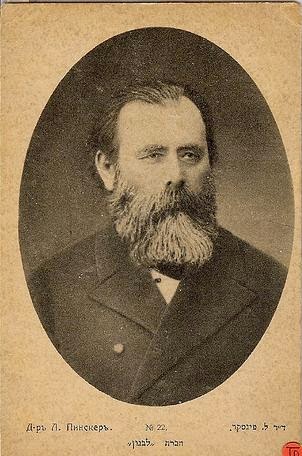 |
| Leon Pinsker |
Essentially, the early Zionists argued that a national return to normal statehood would resolve this problem. Gordis argues that history has proven them wrong. But is that fair? Have we returned to the status of a normal nation? If not, then the Zionist hypothesis has not been tested in a fair experiment.
Assuming that there is any validity at all to Jewish population statistics, I don’t see how the state of Israel represents a normal nation at all. Of approximately fourteen million Jews, around six of those millions live in their homeland. That’s not normal.
Is there another nation on earth that has 57% of it's population living outside of it's homeland? And that diaspora population continues to grow, build institutions, take positions of power and see itself as a permanent part of their host nation’s culture. Even putting aside dual loyalty concerns, this is truly odd. Creating a home that 43% of a people live in, and most of the rest feel connected to is, I would argue, not the Zionist answer to the Jewish Question proposed by the Zionists.
Since the destruction of the First Temple, the Jewish majority has lived outside of it's homeland and saw that as normal. That comes to around 2,600 years since Israel contained most of our people. How did Pinsker describe the problem?
“In the case of a sick man, the absence of desire for food is a very serious symptom. It is not always possible to cure him of this ominous loss of appetite... The Jews are in the unhappy condition of such a patient. We must discuss this most important point with all possible precision. We must prove that the misfortunes of the Jews are due, above all, to their lack of desire for national independence; and that this desire must be awakened and maintained in time if they do not wish to be subjected forever to disgraceful existence -- in a word, we must prove that they must become a nation.”
Again, I would argue that regaining our homeland is a crucial step towards normalization, but not the achievement of the goal itself. Did those early Zionist thinkers promise that this process would go quickly and easily? Quite the contrary. Give them their due. I think that they have been right on target so far.
It took three hundred years, from Joshua to David, to build a stable base for our people in the first commonwealth. After centuries of Judean life in the second temple period, we never managed to achieve all of our goals. Why would we expect a two thousand year exile to lead us to a speedy renormalization from wandering ghost people to healthy stable nationhood?
In short, everybody should read Auto-Emancipation and Der JudenStaat. They are short, brilliant and powerful. (and I skipped all the economics stuff)
 |
| Theodor Herzl |
MNUnterberg
Wednesday, January 22, 2014
Thursday, August 1, 2013

Sunday, July 14, 2013

Sunday, January 6, 2013

Wednesday, July 4, 2012

Tuesday, June 5, 2012

Friday, May 25, 2012
I made the big Times! Top spot on TOI!
1) Mea Culpa: First of all, I feel really guilty that I didn't mention in my second blog post that Dara told me those Rav Medan insights.
2) Mea Kvela: I know that the topic was a serious one, but I am so happy and honored to be today's featured blog on the Times of Israel! They posted a catchy title, even added pictures and tinkered with some of my transliteration! Really cool and flattering.
I don't mean to distract from the serious point of the piece, but on a purely personal level, I'm jazzed!
Chag Sameach!
MNUnterberg
2) Mea Kvela: I know that the topic was a serious one, but I am so happy and honored to be today's featured blog on the Times of Israel! They posted a catchy title, even added pictures and tinkered with some of my transliteration! Really cool and flattering.
 |
| The featured spot (right above Neil Lazarus) |
 |
| They added a nice Rut pic... |
 |
| And this captioned photo of refugees! |
Best of all, because I was the lead feature of the day, my little post appears right under David Horovitz's on the side bar:
 |
| Look, I call for stuff!!! |
Chag Sameach!
MNUnterberg
Thursday, May 24, 2012

Wednesday, May 23, 2012
My new blog at Times of Israel
Well, I now have my own blog at David Horovitz's Times of Israel online newspaper. I have been a big fan of Horovitz for years, so I'm pretty proud and pleased.
Basically, I will be posted Israel related posts there first, and then adding them here a few days later. My first post is one that appeared here previously, and I will repost it here soon. I guess you can choose to follow one, both or neither.
Thanks!


MNUnterberg
Basically, I will be posted Israel related posts there first, and then adding them here a few days later. My first post is one that appeared here previously, and I will repost it here soon. I guess you can choose to follow one, both or neither.
Thanks!


MNUnterberg
Tuesday, May 1, 2012
Israel: Theocracy or Democracy Lecture
You can download most of the audio from my lecture by following this link,
the Power Point can be found at this link,
And the source sheet can be found here.
If you prefer, here is a folder that holds all three.
Enjoy!

MNUnterberg
the Power Point can be found at this link,
And the source sheet can be found here.
If you prefer, here is a folder that holds all three.
Enjoy!

MNUnterberg
Monday, April 23, 2012

Tuesday, March 27, 2012
Pigs and Parasangs
The Rabbis learn the idea of constancy and consistency from our parsha. The sacrifices are not only important in themselves, but also as a symbol of our need to never shirk our burden of responsibilities to Hashem. It is seen in the following verse:
The Talmud discusses a time when Jewish infighting brought the constant service in the Temple to a stop. It occured during the second temple period under the hasmonean dynasty. Two grandchildren of the Maccabees were fighting a war over who would run the country and the Temple. The event is described as follows:
This event may contain some rabbinic hyperbole, but it is no legend. The Jewish historian Josephus reports what is essentially the same event. And he too shared the Rabbi’s sense of righteous indignation and articulates it in no uncertain terms.
It is often stated that sinat chinam (inappropriate conflict between Jews) brings disaster to our people. It is also worth remembering that it make the proper constant and consistent service to Hashem impossible.
Rav Avraham Yitzchak HaCohen Kook is often quoted as saying that since the Second Temple was destroyed through sinat chinam, the third one will have to be built through ahavat chinam. (baseless love) May Jewish love for our fellows continue to grow and bring the redemption closer every day.

MNUnterberg
Vayikra 6:2
Command Aaron and his sons, saying: This is the law of the burnt-offering: it is that which goes up on its firewood upon the altar all night unto the morning; and the fire of the altar shall be kept burning thereby.
The Talmud discusses a time when Jewish infighting brought the constant service in the Temple to a stop. It occured during the second temple period under the hasmonean dynasty. Two grandchildren of the Maccabees were fighting a war over who would run the country and the Temple. The event is described as follows:
Baba Kamma 82b
IT IS NOT RIGHT TO BREED PIGS IN ANY PLACE WHATEVER. Our Rabbis taught: When the members of the Hasmonean house were contending with one another, Hyrcanus was within and Aristobulus without [the city wall]. [Those who were within] used to let down to the other party every day a basket of denarii, and [in return] cattle were sent up for the regular sacrifices. There was, however, an old man [among the besiegers] who had some knowledge in Grecian Wisdom and who said to them: 'So long as the other party [are allowed to] continue to perform the service of the sacrifices they will not be delivered into your hands.' On the next day when the basket of denarii was let down, a swine was sent up. When the swine reached the centre of the wall it stuck its claws into the wall, and Eretz Yisrael quaked over a distance of four hundred parasangs by four hundred parasangs.
This event may contain some rabbinic hyperbole, but it is no legend. The Jewish historian Josephus reports what is essentially the same event. And he too shared the Rabbi’s sense of righteous indignation and articulates it in no uncertain terms.
Antiquities of the Jews - Book XIV 2:2
While the priests and Aristobulus were besieged, it happened that the feast called the passover was come, at which it is our custom to offer a great number of sacrifices to God; but those that were with Aristobulus wanted sacrifices, and desired that their countrymen without would furnish them with such sacrifices, and assured them they should have as much money for them as they should desire; and when they required them to pay a thousand drachmae for each head of cattle, Aristobulus and the priests willingly undertook to pay for them accordingly, and those within let down the money over the walls, and gave it them. But when the others had received it, they did not deliver the sacrifices, but arrived at that height of wickedness as to break the assurances they had given, and to be guilty of impiety towards God, by not furnishing those that wanted them with sacrifices. And when the priests found they had been cheated, and that the agreements they had made were violated, they prayed to God that he would avenge them on their countrymen. Nor did he delay that their punishment, but sent a strong and vehement storm of wind, that destroyed the fruits of the whole country, till a modius of wheat was then bought for eleven drachmae.
It is often stated that sinat chinam (inappropriate conflict between Jews) brings disaster to our people. It is also worth remembering that it make the proper constant and consistent service to Hashem impossible.
Rav Avraham Yitzchak HaCohen Kook is often quoted as saying that since the Second Temple was destroyed through sinat chinam, the third one will have to be built through ahavat chinam. (baseless love) May Jewish love for our fellows continue to grow and bring the redemption closer every day.
MNUnterberg
Friday, March 9, 2012
A History of Mizrachi Comedy
Here is a playlist that takes you through the years of Mizrachi Comedy Movies
And then there are the ones not on Youtube, that you can see here:
MNUnterberg website

MNUnterberg
And then there are the ones not on Youtube, that you can see here:
MNUnterberg website

MNUnterberg
Friday, February 3, 2012
Isn't it great when you might be wrong?
I have a particular interest in this story from today's Haaretz:
For a number of years it has bothered me that Rabbinic tradition says that the Torah refers to the etrog (citron fruit) specifically (in Vayikra 23) when it explains the mitzva of the four species on Sukkot. For example, Maimonides says:
ב "פרי עץ הדר" (ויקרא כג,מ) האמור בתורה, הוא אתרוג.
"The fruit of a beautiful tree" referred to in the Torah is the citron fruit.
The entire article is worth reading, but the part relevant to my problem is:
Most of the plants were wild, but in one layer of plaster, apparently from the Persian period (the era of the Jewish return from the Babylonian exile in 538 B.C.E. ) they found pollen from ornamental species and fruit trees, some of which came from distant lands.
The find that most excited the scholars was pollen from etrogs, or citrons, a fruit that originated in India. This is the earliest botanical evidence of citrons in the country.
Scholars believe the citron came here via Persia, and that its Hebrew name, etrog, preserves the Persian name for the fruit - turung. They also say royal cultivation of the exotic newcomer was a means of advertising the king's power and capabilities.
The garden at Ramat Rachel is also the first place in the country to yield evidence of the cultivation of myrtle and willow - two more of the four species used in Sukkot rituals.
See the problem? If etrogim, according to the evidence, only arrived in Israel during the second temple period, than the Torah couldn't have meant them hundreds of years before the first temple was built! This would mean that the Rabbis were in error. Admittedly, this would not amount to faith shaking heresy, just an interesting trivial point. But still. At least I thought it was interesting. I've basically assumed for years that the Rabbis were wrong.
BUT!
In fishing around after reading today's article, I found out something new. (for me) There is some evidence that the etrog had travelled to Egypt sometime before most assumed dates for the Exodus story. While no actual physical remains of etrogim have been found, images of what appear to be citrons on the walls of the Temple of Karnak have! Apparently they appear in the Akh-Menou hall from the time of Thutmose III, which would date it to the 15th century B.C.E. That would be well early enough for Moshe and his contemporaries to be familiar with them. There may even be images there of my favorite kind of Etrog, the many fingered Buddha's hand citron!
 |
| I know not everyone agrees, but I think these things are gorgeous. |
So there is some circumstantial evidence that the Torah could possibly have meant the etrog, and that the Rabbinic tradition is true. Of course, there are still questions. For example, the hebrews would then have had to bring loads of them into Canaan, and there should be some evidence of that.
But its still nice to see that the answer to my question was not as simple as I had originally thought. I just love it when things are more complicated than I thought, and there is so much more to figure out! Now I just have to convince my high school students to share that attitude.
MNUnterberg
Monday, January 30, 2012
Great post from my brother-in-law
You can see it on its page here, but here is the post:
The Religious Cost of Rejecting Feminism’s Core Moral Claim
by Yosef Kanefsky

MNUnterberg
Wednesday, January 11, 2012
Check it out. I just rated [Fresh Prince Of Mizrachi: Welcome Back] on the Day School Video Academy Awards. #JDSVA #jed21
Voting starts tomorrow! Please vote so our school can win money! Check it out. I just rated [Fresh Prince Of Mizrachi: Welcome Back] on the Day School Video Academy Awards. #JDSVA #jed21
MNUnterberg
MNUnterberg
Subscribe to:
Posts (Atom)